
Part 1 of the Transcendence Series
Brain in a Jar
Imagine suspending your brain in a jar where it can’t see, hear, touch, feel, or smell. Anything!
Sounds interesting? Let’s find out how sensory deprivation works.
I have always been fascinated by the fact that human beings can manipulate the brain into having experiences that are outside the ordinary; that we can induce experiences that are beyond the norm. It brings to fore the plasticity of our brains – not only do our brains allow such interruptions into their ‘normal’ mode of operation, but also that there’s no real ‘normal’ – everyone experiences reality differently. The redness of an apple may appear different to me than to you. This specific, subjective experience is known as qualia.
So when I first read about sensory deprivation it captivated me. I don’t remember now what my first introduction to this idea was, but I’m certain it must have been a book or one of those late night Wikipedia wormholes.
The basic premise of sensory deprivation is to starve the brain of sensory inputs. Generally, one would cover their eyes, block their ears, and lie down, unmoving and relaxed. After a few minutes of this sudden lack of stimulus, the brain begins to become restless, and, like people whistling in the dark, starts manufacturing its own stimulus. The mind will agitate, as it’s not used to being away from the otherwise constant barrage of inputs day-to-day living provides a normal brain.
It occurs to me as I write this that sensory deprivation is in some ways the opposite of listening to heavy metal music. The uninterrupted cacophony of heavy metal might actually bludgeon any thought or feeling, and allow little chance for any other stimulus to get through. Brute force. I haven’t tried it, but I might for the sake of science.
Flotation Tanks
What I have tried is something called sensory deprivation tanks, or flotation tanks. These contraptions take the concept to its natural end. They are purpose built to keep external senses from reaching the mind, and I tried it for the first time about 6 years ago, at the 1000 Petals Spa in Indiranagar, Bangalore:
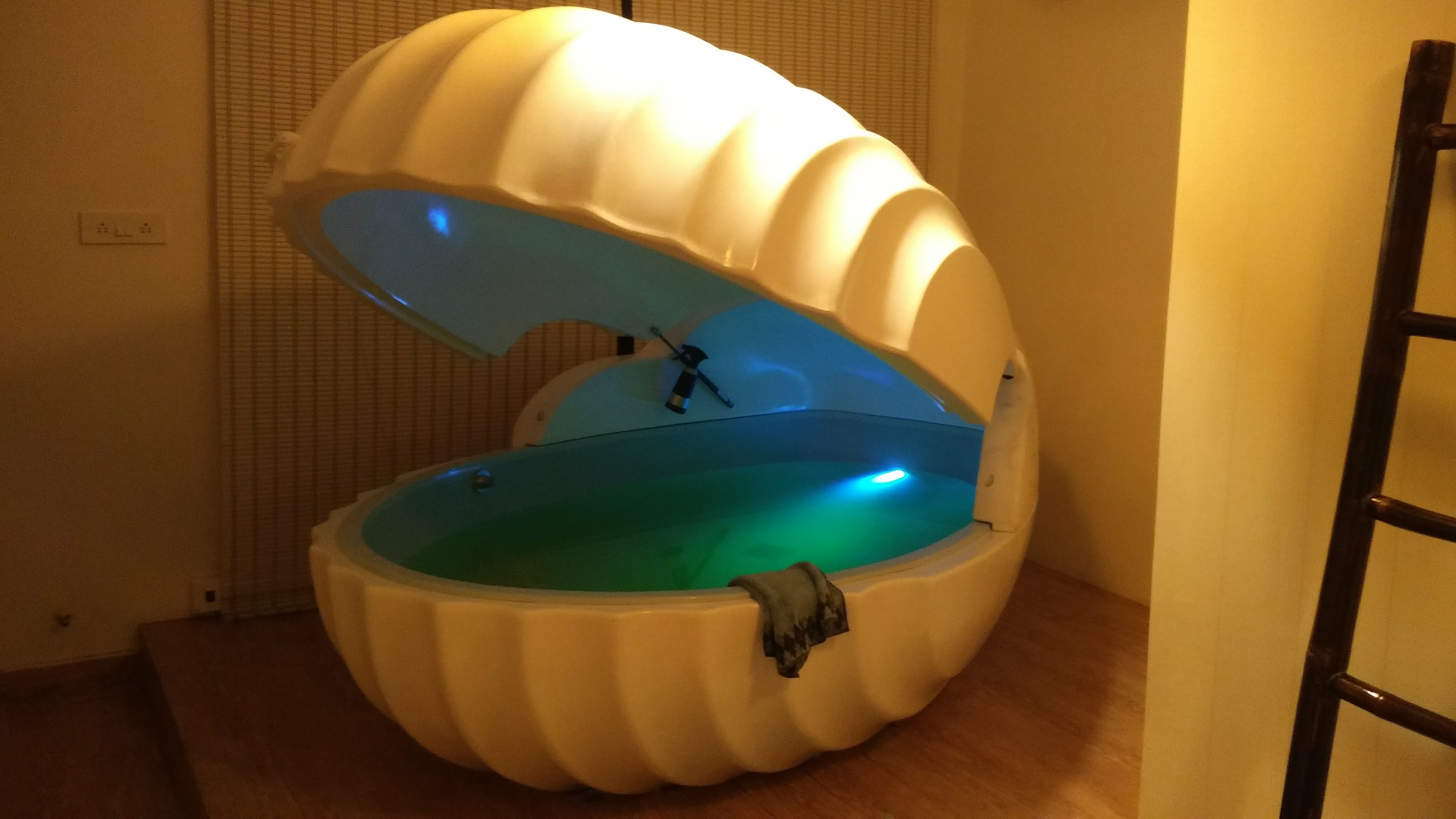
I enter alone into a moodily-lit room with a large, white tank best described as a ceramic oyster. I get this vivid picture in my mind of that I will come out of this experience looking like a shiny pearl. The top of the oyster-tank is open, and inside I see it is filled with water heated to match the temperature of your body. The water is heavily saturated with Epsom salts, such that when I strip and enter the tank and lie down, my body gently floats. I cannot sink because the water is so dense (just like the Dead Sea).
Subtracting the Senses
The body-temperature water takes away my ability to sense with my skin. In the beginning, it feels strange and weird. My body is ‘feeling’ the senselessness, and the water somehow feels sluggish. In a few minutes, my body’s temperature has reached equilibrium with the temperature of the water, my internal senses have adapted and it begins to ‘feel’ like nothing.
One sense down, and a big one. We may not be conscious of it, but skin and touch play a major role in informing our mind of the body’s position and status.
Once I am settled, I close the lid of the tank, and darkness descends. There’s a tiny light that you can switch on until you find your bearing or if you feel uncomfortable, but the idea is to get rid of the light. So lights off. Now, eyes open or closed, I can’t see a thing. Two down, and another big one – 80% of sensory information is fed in by the eyes.
The enclosed tank is soundproof, which takes away the ability to hear anything except your own breathing. Strike three.
So then there I am, gently floating, blind, deaf, and without the ability to sense my body in space. Except for the gurgling of my tummy, which is louder than usual in the silence, I could be just as easily be a brain suspended in liquid. I am initially at rest, at peace, curious of this new experience, looking around but seeing nothing, hearing nothing, and feeling nothing. After a few minutes of this deep silence, I realize that my mind has less to do. Gigabytes of data has stopped coming in, and all that processing power is available and un-used, perhaps for the first time ever. At first, this thought feels luxuriously relaxing. But as time passes by, my mind grows restless, even irritated at the lack of engagement. The brain needs to be fed – it is a simulation engine (a Bayesian one, if you want to dive in deeper). And when it isn’t fed, it panics and starts making stuff up.
As the seconds turn into minutes, the sense of detachment becomes unsettling. My mind yearns for stimulation, craving the rich tapestry of experiences that it was once accustomed to. It delves deeper into the recesses of memory, grasping onto fragments of past encounters, seeking solace in the familiar. Visions of sunlit fields and bustling city streets dance before my eyes, the sensory details vivid and palpable. I can almost feel the warmth of the sun on my skin, hear the sounds of laughter and conversation mingling in the air. But alas, they are mere illusions, constructed by a mind desperate for connection.
My thoughts wander to the people I’ve known, the bonds forged over a shared journey through life. Faces blur together, their once vibrant expressions fading into a hazy fog. A pang of longing fills my being, wishing to reach out and bridge the gap between the living and the ethereal.
Yet, amidst the endless exploration, a sense of emptiness lingers. For all the wonders that the mind can conjure, it is ultimately a solitary existence. The absence of true connection, the inability to share these stories with others, casts a shadow over the otherwise vivid tapestry of imagination.
About 15 minutes into the floatation tank, I begin to experience hallucinations! (I am writing all of this from memory, and even after six years, writing these lines bring a smile on my face, as they did back then). Hallucinations are a real-world indicators of the mind trying to adjust to this new reality, and a good measure of the plasticity of our minds.
Hallucinations
At first the hallucinations are auditory. I hear things, small pings and splats, snatches of conversations, raised or forgotten voices. I have experienced hypnagogic hallucinations before (still do sometimes), usually around the time I fall asleep, but these come to me when I am wide awake, although I think at this point my brain can hardly tell the difference.
Then I begin to see colorful dots and flashes of light, colorful brushstrokes in the empty, dark tank. Visual hallucinations, constructed by a mind craving engagement, interaction, even entertainment. But these last only a few minutes at most before the mind gives in and succumbs into the emptiness it hasn’t met since the day I was born.
Back to the Womb
The mind finds itself, essentially, is back in the womb, with nothing to do but to be primal. This is an easy comparison to make – within the womb, we were in a similar environment, floating in the dark with the sound muffled. (Imagine what a child goes through when it exits the calm, silent safety of the womb and enters this world of chaos and noise, the onslaught of all the senses cranked up to 11 all at once. It must feel like… heavy metal).
Somewhere around here my mind stopped thinking, and I fell into a stateless phase of the mind that was like sleep but not exactly. My mind floated as peacefully as my body. I was aware only of time passing, of the weird sensationless-ness of my skin, body and mind, and perhaps even lost touch with my identity.
An Experiment with Presence
I came back to the sound of music being piped into the ‘oyster’ tank, an indication that the session was over, and instinctively touched my fingers with my thumb. I had forgotten I could ‘manufacture’ stimulus this way, and it was good that I did so until the end of the session. As I slowly exited the tank, I had this sense that more time had passed than actually had, and that I could measure each action without rushing past anything.
In retrospect, the whole thing was a vast meditation session, a crash course in the art of presence, mindfulness through mindless-ness. For weeks afterward I carried this experience within me, a bubble of timelessness that acted like a buffer and kept me equidistant from the small miseries of daily life. I recognized this ‘bubble’ immediately, welcomed it like an old friend even, as I have felt it before in the aftermath of another similarly unique experience, something called the ‘Singing Bowl’ meditation. I will write about it in another post.
If you are curious about your mind or curious about this experience, I urge you to search for a floatation tank near you and give it a try. I’ve noticed that Spas generally sell a 60 minute and a 90 minute session, and I would recommend the longer one by default.
Until next time.

 Rohit Nalluri
Leave a comment