
A Lost Opportunity
In my own estimation, I made a fool of myself recently. When a friend asked me why I donate to makesunsets, a climate action startup that injects Sulphur dioxide into the stratosphere to combat greenhouse gas induced heating, my answer was feeble, lazy and not put together at all, which in retrospect hurts, as I am passionate about climate change and climate resiliency, and this was an opportunity to inspire and perhaps recruit more people in the fight for the survival of life on Earth (I refuse to spin climate change as something dangerous for the planet itself, because the planet will be fine, but if we continue with business as usual, we are cooked).
I thought it through and realized that while my motivations were clear to me intrinsically, I hadn’t really crystallized them on paper.
So this is an attempt to structure my thoughts on why I believe in giving to climate-friendly initiatives, why I have done so since 2015, why SAI (Stratospheric Aersol Injection) is a game changer, and why I donate specifically to makesunsets.
A world on the verge of catastrophe
For millions of years, CO2 levels in our atmosphere have fluctuated between 180 to 280 parts per million. The more CO2 in the atmosphere, the hotter the planet will get. A good example of this is Venus, where uncontrolled carbon dioxide levels have increased the mean temparature of the planet to 450 degrees celcius.
In the last 200 years, human industry has skyrocketed CO2 numbers to 420 ppm and above. As a specie, we have never lived in the conditions we live in today. And we continue to modify, experiment and dangerously manipulate a planet which is the only abode we have, and the only known planet in the cosmos to harbor life.
As I write this I am in balmy Copenhagen, enjoying a rare, blue-sky day with the sun streaming in. A little further south though, Europe is suffering through its third heat wave in four years. While an unusually warm Paris prepared to host athletes from around the world for the Olympics, NASA declared July 22nd, 2024 as the hottest day ever recorded. In fact, the last 13 months have been the hottest ever for their respective averages.
Wildfires are increasing, burning carbon sinks that further devastates our ability to fight back. The added heat is warming the oceans, reducing their ability to cool the planet, increasing the number of storms as well as their ferocity, which is bad news for coastal communities.
The icecaps are reducing in their size and reach, reflecting lesser and lesser sunlight (reducing what is called the ‘albedo’ of the planet), dumping millions of liters of fresh water into the sea, raising sea levels and slowly killing the single largest source of fresh water we have on the planet. This suicidal climate chain reaction is triggering the release of methane that has been trapped under the icecap for millions of years. Unfortunately, methane is not only a greenhouse gas, but one that is 28 times more potent than CO2.
We are, literally and figuratively, on thin ice.
That’s the bad news.
The good news is that humanity is finally taking action. More of our energy comes from renewable sources, with China, the US and India leading the way in Solar and Wind energy installations. India is building the largest Solar Park in the world, with 63 GW of its electricity coming from renewable sources in 2022. An amazing 92% of new electricity capacacity added in India in 2022 was from Solar and Wind!
China has quickly become a behemoth in this space. In the first five months of 2024, China added 99 GW of electricity generation capacity through Solar and Wind farms. For comparison, all of US’ electricity generation capability adds to 1200 GW. China just added 1/12th of that in 5 months.
It is also looking possible that this will be the last year where China’s share of CO2 emissions continue to rise. In other words, China may have reached ‘peak CO2’, and from next year, for the first time since the Industrial age began, their CO2 emissions will fall. All this is great news for humanity in general, as China is the largest polluter in the world, followed by the US and India.
But…
What happens to the emissions already in the atmosphere? Let’s say that all the big polluters reach emissions peak by 2035 and we begin to see drastic reductions in emissions from 2040, there is still the question of all the carbon and methane we have spewed into the atmosphere for the last 250 years. It will continue to float there, trapping heat and warming the planet, for a long time to come.
The next three or four generations will pay severely from the lasting impact of all those emissions, unless we find ways to remove these gases from the atmosphere. Here we enter the territory of Permanent Carbon Removal, a controversial and as yet unproven concept that aims to remove latent carbon dioxide from our atmosphere and return it to pre-industrial levels. (Quickly touching on why its controversial: permanent carbon removal is as yet a ‘hopeful’ idea. Also, carbon removal is used as a defense mechanism by the fossil fuel industry to continue spewing millions of tons of carbon in the hope that someday someone will come along and ‘vacuum’ all the greenhouse gas out of the air. Hope is not a strategy).
Even proponents of carbon removal agree that technologies like Direct Air Carbon Capture (DACCs) are at least two decades away. And while China renews its energy pipeline at breakneck speeds, the rest of the world is yet to catch up. Even if they do, it will take the rest of the world a couple of decades to reach peak CO2.
We need an interim solution, a stop-gap that could reduce the impact of existing greenhouse gases on the temperature of the planet, something that is natural, proven to work, easy to deploy, easy to scale, cost effective and whose side-effects are well understood.
Enter Stratospheric Aerosol Injection
SAI is the concept of releasing Sulphur Dioxide (SO2) above 66,000 ft. Why? Because at that altitude, the SO2 particles essentially become a mirror, and reflect sunlight (and warmth) back into space. Translating warmth and sunlight into carbon dioxide units is difficult, but scientists calculate that 1 gram of SO2 deployed in the stratosphere is equivalent to mitigating 10 tons of carbon dioxide. Since the beginning of the industrial age, we have added about 2 trillion tons of CO2 to the atmosphere, and to offset the heating from all that carbon dioxide, we need to inject two million tons of SO2 into the atmosphere every year.
Let’s see if SAI fits our requirements:
- Is it natural?
- Nature has been injecting SO2 into the atmosphere and cooling the planet for millions of years already. How? Volcanoes! Each volcanic eruption injects millions of tons of sulphur dioxide into the upper atmosphere, and the climate post that explosion is noticeably different. For example, the Mount Pinatoba volcanic eruption of 1989 injected 20 million metric tons and cooled the planet by 0.5 degrees celcius. That may sound like nothing, but that’s cooling at a planetary scale!
- Is it proven?
- Yes, nature has been experimenting with it for millions of years. But humans have (or had) been doing that, too! Until 2017, the sea shipping industry was emitting 8 million tons of SO2 because the fuel they were using had sulphur. This was banned in 2017, and we can see the negative effects of that as every year since then has been hotter than before. Without knowing it, shipping fuel was contributing to cooling the planet and protecting the climate from heating! (Sulphur in the lower atmosphere is bad for humans, which is why sulphur in shipping fuel was banned. The idea of SAI is to inject sulphur only in the upper atmosphere, far away from humans.)
- Is it easy to deploy/scale?
- Yes, a simple balloon can carry SO2 into the upper atmosphere. Make Sunsets has their deployment rigged in such a way that the balloons release SO2 only after reaching the target altitude, and cooling credits are only issued if they can confirm via telemetry that the balloon reached the required height. It’s easy enough to make your own SAI Balloon at home and launch it.
- Is it cost effective?
- Yes, at $10/70 DKK/850 INR per 10 tons of CO2 offset, this is one of the (if not THE) cheapest ways to offset one’s carbon footprint.
- Are the side-effects are well understood?
- Yes, and there’s already a well written article by Tomas Pueyo on this, so I won’t go into it except to say that while they are well understood, they are alarmist at worst, cautionary at best, and there is no side-effect more debilitating than the 250 years of carbon regime we have endured.
Why makesunsets?
If SAI is so good, why isn’t everyone doing it? Why aren’t governments synchronizing and releasing 2 million tons of SO2 per year to deflect the heat until we get our climate in order? A few reasons:
- SAI is seen as ‘geoengineering’ and there are fears that engineering the planet at this scale may have unforeseen repercussions.
- My argument against this thinking: We have been conducting a three century long engineering experiment on the planet, and whatever we have dreaded are already happening. At no point in millions of years did the planet go above 280 ppm of CO2, meaning this is not an experiment that the planet undertook. However, for millions of years it has been injecting SO2 into the upper atmosphere through volcanoes, and cooling the planet. Why are we so unwilling to take up this experiment?
- There is no central authority that can or will ‘approve’ SAI.
- Geoengineering is illegal in some countries.
Makesunsets is the first agency that I have come across that is taking Sulphur injection by the horn and actually taking action, month on month. They are located in California, and go out to the country every month to release balloons filled with SO2 into the atmosphere. They are directly responsible for a significant amount of cooling that the planet experiences. This is a level of climate vigilantism that I can get behind.
As a nature lover, and as someone who obtains a huge amount of inspiration and the sheer joy of life from nature, I have always considered myself a climate activist. Within my means, I have been donating to Greenpeace since 2015, even when it did stretch my budget a little. But I have started to think that Greenpeace is too slow. What makesunsets is doing is democratic, accessible, and tickles my DIY-spirit. It is also a big fuck-you to the fossil fuel industry and climate change deniers, although I am concerned that a planet cooled by SAI will bring them out in force. Here, with makesunsets, I can see my monthly contributions having a slow but sure impact.
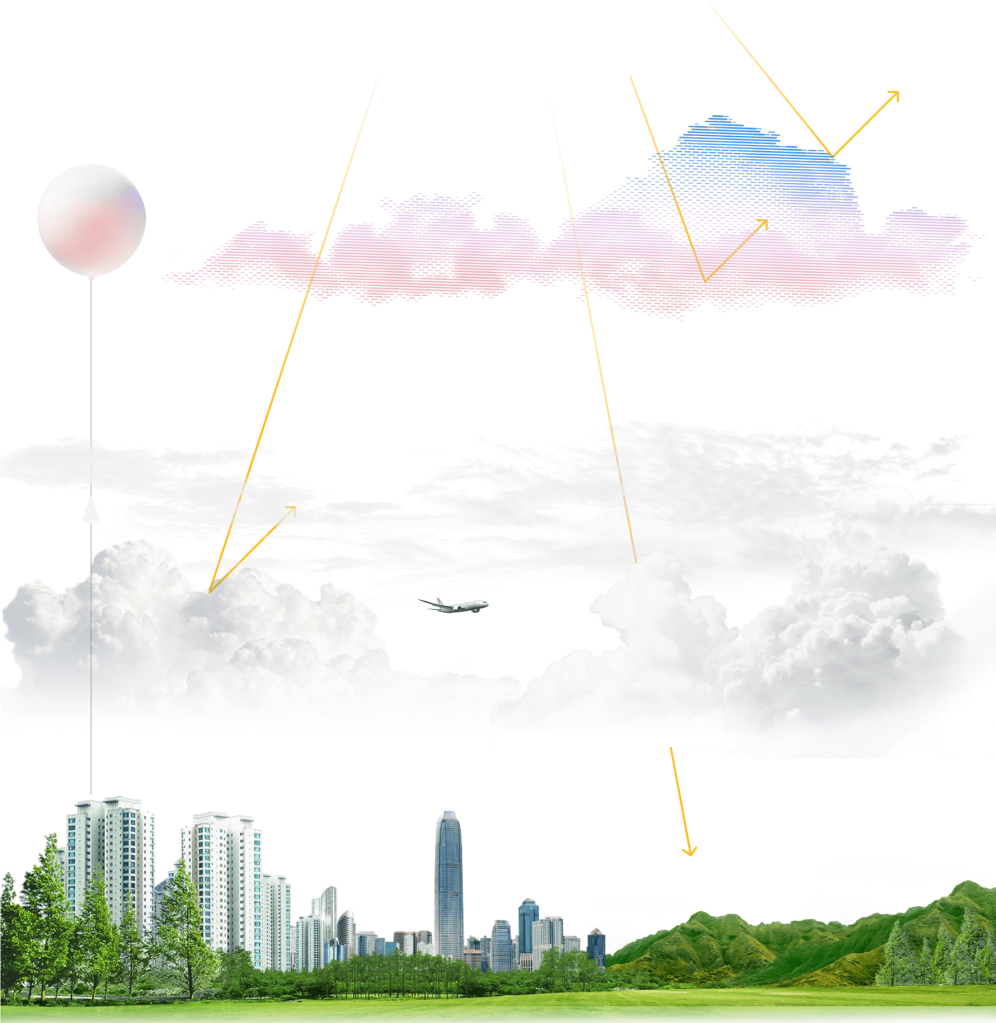
makesunsets deploy Sulphur Dioxide above 12.4 miles (20km) from the Earth’s surface using balloons. The reflective clouds of SO2 stay up for about a year reflecting some of the Sun’s rays just like the natural clouds below. Think of it as applying sunscreen spray to protect your skin from the Sun. Just 2.2 pounds (1 kilogram) of SO2 clouds offsets the warming effect of ~2.2 million pounds (one million kg) of CO₂ for a year.
Time for Action!
If any of this makes you curious about Stratospheric Aerosol Injection, Sulphur Dioxide, or geoengineering, please give this excellent article by Tomas Pueyo a read. It will allay any doubts you may have about SO2 injection, and it was this article that turned me on to makesunsets.
If you are already a believer, I urge you to sign up to the makesunsets cooling credits here. Every month, they will send you an email with photos and videos of the balloon launch made in your name that just eliminated 10 tons of CO2 heating from the planet for just $10 per month. The link will default to a $30 credit, if you can afford that, please contribute. If not, you can customize your subscription by clicking on the ‘custom subscriptions’ link.
I personally mitigate 10 tons of CO2 per month, and unless the science changes, I see myself being a lifelong contributor. I came to this number by calculating my carbon footprint, which came to 97 tons over the last 36 years of my existence on this planet. I think of that number as my Karmic debt to the planet that hosts me, that lets me live, love, play and be curious. It is also a burden I owe to all the other living beings that share this miraculous planet, who have contributed so little to this man-made catastrophe and yet mutely bear the brunt of it, and almost always in the frontlines of it. This is a burden that cannot be quantified, let alone rectified. It can only perhaps be salvaged, bit by bit, gram by gram.


 Rohit Nalluri
Leave a reply to Sriharsha Marutheswar Cancel reply